Understanding training and test data in Machine Learning
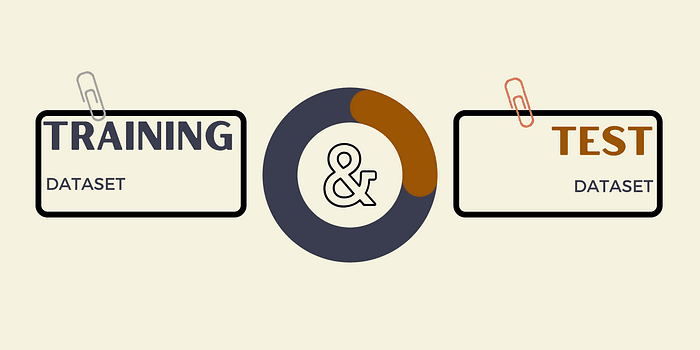
What is training and testing data in machine learning? In machine learning, datasets are split into two subsets. The first subset is as the training data - it's a portion of our actual dataset that is fed into the machine learning model to discover and learn patterns. In this way, it trai
What is training and testing data in machine learning?
In machine learning, datasets are split into two subsets. The first subset is as the training data - it's a portion of our actual dataset that is fed into the machine learning model to discover and learn patterns. In this way, it trains our model. The other subset is known as the testing data.
Purpose of training and testing a machine learning model
To accurately assess your ML model's performance without overfitting or underfitting issues, it's necessary to split your dataset into two separate sets: Training set: Helps train the algorithm on real-world examples.
Testing set: Used later for evaluating its generalization capabilities on unseen instances.
How much data should be used for training and testing?
We first train our model on the training set, and then we use the data from the testing set to gauge the accuracy of the resulting model. Empirical studies show that the best results are obtained if we use 20-30% of the data for testing, and the remaining 70-80% of the data for training.
How to split your Machine Learning data?
Some common inferences that can be derived on dataset split include:
If there are several hyper-parameters to tune, the machine learning model requires a larger validation set to optimize the model performance. Similarly, if the model has fewer or no hyper-parameters, it would be easy to validate the model using a small set of data.
If a model use case is such that a false prediction can drastically hamper the model performance—like falsely predicting cancer—it’s better to validate the model after each epoch to make the model learn varied scenarios.
With the increase in the dimension/features of the data, the hyper-parameters of the neural network functions also increase making the model more complex. In these scenarios, a large split of data should be kept in training set with a validation set.
Advanced techniques for data splitting
Various data splitting techniques have been implemented in the Computer Vision literature to ensure a robust and fair way of testing machine learning models. Some of the most popular ones are explained below.
1. Random
Random sampling is the oldest and most popular method for dividing a dataset. As the name suggests, the dataset is shuffled, and samples are picked randomly and put in the train, validation, or the test set based on what percentage ratio is given by the user.
1. Stratified
Stratified sampling for splitting a dataset alleviates the problem of Random Sampling in datasets with an imbalanced-class distribution. Here, the distribution of classes in each of the train, validation, and test sets is preserved.
1. Cross-Validation
Cross-Validation or K-Fold Cross-Validation is a more robust technique for data splitting, where a model is trained and evaluated “K” times on different samples.
Mistakes made during splitting dataset
Underfitting-> Underfitting happens when a model has not learned the patterns in the training data properly and is unable to generalise adequately on the new data. An underfit model performs badly on training data and makes erroneous predictions. Underfitting occurs when there is a significant bias and a low variance
Overfitting -> Overfitting happens when a model performs extraordinarily well on training data but badly on test data (fresh data). In this case, the machine learning model learns the details and noise in the training data, which has a negative influence on the model’s performance on test data. Overfitting can develop as a result of low bias and high variance.
Conclusion
“Training data teaches a machine learning model how to behave while testing data evaluates how well the model has learned.”
The difference between training data and testing data is that training data tells you how to build a model, and testing data tells you how to break it.
Training data and Testing data are the most essential to understand to build accurate and reliable machine-learning models. By carefully selecting and preparing the data, you can improve your models’ performance and ensure they are ready for real-world use.

 Let's talk about your next project!